

Just to show that I'm not biased, here's what wired came up with, against the iPhone:
At the risk of sounding churlish—we love the iPhone, we truly do, and will sacrifice our children to get our hands on one—not all is perfect behind the pearly white gates of heaven. Here are the top five worst things about the phone, media player, computer and news frenzy:
1) Cingular. They're North America's largest cellular network, so it makes sense for Apple to deal with them. But it would have been far better if Apple had taken on the carriers' chokehold on handset provisioning wholesale, and simply sold unlocked phones.
2) 8GB Flash drive. For many, it will be more than enough, but the iPhone won't kill the iPod until drive sizes start matching the needs of MP3-era music libraries. My fear is that Apple will stick to its guns and stick with Flash media as it grows to 16GB and beyond, but a second-gen iPhone with magnetic storage is an obvious upgrade path.
3) Built-in battery. Apple's bothersome tradition of non-user-servicable batteries continues. There's no reason to do this, frankly, aside from the kind of implied "we're aesthetic obsessives" claim that Apple still gets away with.
4) No 3G. Fast internet is the horse, 3G is one hind leg.
5) With all those features, a QWERTY keyboard stashed within (somehow) would be the perfect way to turn this little beast into Apple's answer to the UMPC: a cheap, fully-featured computing device in addition to a phone and music player. Even a clamshell...
And I promise, that's all for this week about the iPhone...
Showing posts with label apple. Show all posts
Showing posts with label apple. Show all posts
iPhone Quotes
"Apple Makes My Head iSplode"
“I Feel Like a Caveman For Using Phone Numbers.”
“Who The Hell is Going To Want Anything Else Ever Again?”
"No parent wants to buy their kid a $600 phone, but I think it will make iPods that much cheaper."
"Looking at the specs of this iPhone, it looks like fanart gone wild."
"I don't think anybody is going to be looking at these phones in the same way again"
"It's definitely a compelling product"
"I live in an area that doesn't get Cingular. Everyone can get stuffed."
"So sleek, so clean, so pretty. What is it about Apple products that makes them
look so yummy?"
"Apple have done it again!"
“I Feel Like a Caveman For Using Phone Numbers.”
“Who The Hell is Going To Want Anything Else Ever Again?”
"No parent wants to buy their kid a $600 phone, but I think it will make iPods that much cheaper."
"Looking at the specs of this iPhone, it looks like fanart gone wild."
"I don't think anybody is going to be looking at these phones in the same way again"
"It's definitely a compelling product"
"I live in an area that doesn't get Cingular. Everyone can get stuffed."
"So sleek, so clean, so pretty. What is it about Apple products that makes them
look so yummy?"
"Apple have done it again!"
The iPod is Dead...
 Well, maybe not quite, but with the announcement of the new iPhone, there seems little point in innovating the iPod, besides making the shuffle small enough that it can be worn as an ear-ring.
So once again Apple revolutionises the computer world, and removes the word computer from it's name, essentially saying that they're not just a computer company anymore.
So the iPhone is an iPod looking telecommunications device with a 2 megapixle camera, up to 8GB of RAM, all the features of the latest video iPod, revolutionary web browsing that has a touch sensitive multi format screen.
WOW.
I want one. Trouble is, will it work on the current New Zealand networks?
There's going to be a riot.
 Here's my prediction for Macworld: There's going to be a riot.
Expectations for Steve Jobs' keynote speech Tuesday are so unreasonably high that anything less than an iPod-cum-videophone-miniPC that downloads movies wirelessly from the net and projects them on your living room wall with 7.1 surround sound is going to disappoint.
I've seen it before. I remember one year -- I think it was 2002, when rumors ran rampant that Jobs would unveil a mini-tablet device called the iWalk -- when there was a really strange, ugly mood as he reached the end of his speech and the magical device hadn't been announced.
The crowd looked at each other, saying, "Is that it?" Some people started to advance on the area in front of the stage where Jobs was shaking hands with VIPs and industry execs. I guess most of them wanted to buttonhole Jobs and ask what was going on, but one nut case started shouting and pushing chairs as he moved toward the stage. I remember the startled look on the faces of Jobs' handlers as they ushered the Apple chief backstage and out of the loony's path.
Expectations are higher this year, I think, as Apple moves mainstream and grows. There's more money involved. Still, if Jobs doesn't reveal any miraculous new hardware, you might be able to pick up some plunging Apple stock later in the week.
SOURCE | cult of mac
The Fourth Digital Decade...
 The world of desktop computing is finally going mobile, according to The New York Times John Markoff, and the shift can be seen in the explosive growth of wireless data for cellular carriers.
To handle functions from text and instant messaging to mobile MySpace and ESPN, computer users are increasingly turning to the cellphone.
“We are seeing the emergence of a fourth screen,” said Jerry Panagrossi, vice president for operations at Symbian, a developer of advanced cellphone operating systems, citing a historical progression of “movie, television, computer and now the smart-phone screen.”
The newest screen is evolving to adopt more and more characteristics of a personal computer. And many believe that the next big shift will be the convergence of many forms of communication encompassing voice, e-mail, instant messaging and video telephony.
That shift may well be underscored tomorrow when Steve Jobs, the chief executive of Apple Computer, is expected to unveil an Apple phone representing his company’s new mobile communications strategy — highlighted by a device that may include Jobsian refinements such as a sleek ceramic case and a transparent touch screen.
Hhhmmmm, the iPhone… not something to get me all happy clappy, but no doubt it will be a technological marvel that will have me lusting after it, despite the fact that it won’t be supported in New Zealand for the next four years…
Of course Apple is distinctly late in entering the world of Internet-connected digital hand-helds. Arrayed against it are giants including Nokia, Motorola, Sony Ericsson and Microsoft, in addition to entrenched hand-held companies like Palm and Research in Motion.
Also waiting to enter the fray are powerful Internet companies like Google, who cannot afford to be cut off from users who now rely on them in the desktop computing world.
“Apple is about to touch off a nuclear war,” said Paul Mercer, a software designer and president of Iventor, a designer of software for hand-helds based in Palo Alto, Calif. “The Nokias and the Motorolas will have to respond.”
Oh yeah baby, bring it on. Nuclear war baby…
Read the full article here.
The (Apple) Year in Review
January
At Macworld, Jobs releases the first Macs with Intel chips: the iMac and 15-inch MacBook Pro (Apple's top-selling machines, not coincidentally). They're six months ahead of schedule. Apple shares soar to a record high.
February
New Mac minis -- but no TV/DVR features as rumor sites had predicted. Jobs is not yet ready to take on the living room.
March
Apple celebrates its 30th birthday -- with a press release. Jobs doesn't like to look back.
April
Hell freezes over: Jobs announces Boot Camp, which allows his new Intel Macs to boot into Windows.
May
The Beatles lose their lawsuit over the Apple name for music sales. Jobs reportedly uses the defeat to negotiate an exclusive deal to sell the Beatles' catalog online.
The 13-inch MacBook is released, completing the laptop line's move to Intel.
Apple and Nike collaborate on the Nike+iPod -- a wireless iPod pedometer and matching sneakers.
June
The stock option scandal grows. A terse statement says an internal probe has uncovered "irregularities," including a grant to Jobs. But Apple says Jobs didn't benefit financially and is working with the SEC. Dozens of other companies are conducting their own backdating investigations.
July
The iPod craze is far from over. Customers snap up 8.1 million iPods in the July quarter, boosting profits by a hefty 50 percent. New Intel Macs sales aren't too shabby, either: 1.3 million Macs are sold, up 12 percent.
August
Jobs gives a weird tag-team keynote at Apple's annual developers conference, prompting speculation about his health following a cancer scare last year. He gives a preview of Leopard, the next major revision of Mac OS X. There are bells and whistles, but the biggest rumored change -- a major UI overhaul to compete with Microsoft's Vista -- is left out.
September
For perhaps the first time ever, Jobs gives a public sneak peek at an unannounced Apple product: the iTV -- a wireless router for beaming video from a computer to a TV. He also unveils iTunes' first feature-length movies. The movie shelf is initially bare, but more are expected next year.
October
The stock options scandal claims a victim. Fred Anderson, Apple's long-time chief financial officer, falls on his sword and resigns from Apple's board. A statement says Jobs knew of irregularities but not their import. It's a strategic mea culpa that's allowed him to skate -- so far.
November
IPhone mania grips the nation. There's nary a week when the iPhone isn't a major story. The speculation is fueled by patent filings and a lot of wishful thinking.
Apple's stock reaches a new high at $93.
December
The iPhone becomes a slam dunk, even if Apple has never officially admitted it's working on it. Wall Street starts issuing iPhone investor advisories.
But as Jobs himself says: "Looking forward, 2007 is likely to be one of the most exciting new product years in Apple's history."
At Macworld, Jobs releases the first Macs with Intel chips: the iMac and 15-inch MacBook Pro (Apple's top-selling machines, not coincidentally). They're six months ahead of schedule. Apple shares soar to a record high.
February
New Mac minis -- but no TV/DVR features as rumor sites had predicted. Jobs is not yet ready to take on the living room.
March
Apple celebrates its 30th birthday -- with a press release. Jobs doesn't like to look back.
April
Hell freezes over: Jobs announces Boot Camp, which allows his new Intel Macs to boot into Windows.
May
The Beatles lose their lawsuit over the Apple name for music sales. Jobs reportedly uses the defeat to negotiate an exclusive deal to sell the Beatles' catalog online.
The 13-inch MacBook is released, completing the laptop line's move to Intel.
Apple and Nike collaborate on the Nike+iPod -- a wireless iPod pedometer and matching sneakers.
June
The stock option scandal grows. A terse statement says an internal probe has uncovered "irregularities," including a grant to Jobs. But Apple says Jobs didn't benefit financially and is working with the SEC. Dozens of other companies are conducting their own backdating investigations.
July
The iPod craze is far from over. Customers snap up 8.1 million iPods in the July quarter, boosting profits by a hefty 50 percent. New Intel Macs sales aren't too shabby, either: 1.3 million Macs are sold, up 12 percent.
August
Jobs gives a weird tag-team keynote at Apple's annual developers conference, prompting speculation about his health following a cancer scare last year. He gives a preview of Leopard, the next major revision of Mac OS X. There are bells and whistles, but the biggest rumored change -- a major UI overhaul to compete with Microsoft's Vista -- is left out.
September
For perhaps the first time ever, Jobs gives a public sneak peek at an unannounced Apple product: the iTV -- a wireless router for beaming video from a computer to a TV. He also unveils iTunes' first feature-length movies. The movie shelf is initially bare, but more are expected next year.
October
The stock options scandal claims a victim. Fred Anderson, Apple's long-time chief financial officer, falls on his sword and resigns from Apple's board. A statement says Jobs knew of irregularities but not their import. It's a strategic mea culpa that's allowed him to skate -- so far.
November
IPhone mania grips the nation. There's nary a week when the iPhone isn't a major story. The speculation is fueled by patent filings and a lot of wishful thinking.
Apple's stock reaches a new high at $93.
December
The iPhone becomes a slam dunk, even if Apple has never officially admitted it's working on it. Wall Street starts issuing iPhone investor advisories.
But as Jobs himself says: "Looking forward, 2007 is likely to be one of the most exciting new product years in Apple's history."
Apple Gives Movies A Face Lift
Deep inside an industrial building in Burbank, California, stands the Great Wall of Macintosh - a humming barrier of 700 Apple Power Mac G5s, all meticulously stacked, one atop the other, in a U shape 8 feet high and 100 feet long. Alongside sits an equally imposing server bay, which stores a staggering 700 terabytes of data. Upstairs in a hypersanitized, temperature-controlled chamber, a technician wearing white silk scrubs hovers over two mammoth, $300,000 digital film scanners.
Wired Test
This monumental collection of gear provides the mathematical brawn behind DTS Digital Images, the world's premier image-processing and -restoration house. This is where Hollywood films come for a face lift - where torn, faded, dirty or otherwise imperfect footage gets surgically enhanced, whether for the archives, a DVD release or a blockbuster opening weekend.
The human brain behind the operation is John Lowry, a bespectacled, auburn-haired man who, at 74, doesn't look a day older than 60. Over the years, Lowry has become known as the film industry's Mr. Fix-It. The movies he has rescued range from the 1933 Boris Karloff vehicle The Ghoul (in which nitrate film base decay had caused excessive flicker and image distortion) to Michael Mann's recent adaptation of Miami Vice (in which a few shots suffered from low light). Even George Lucas sought out Lowry's expertise for the re-release of the Star Wars trilogy ("Lucas hates grain," Lowry says). And MGM hired Lowry to restore all 20 James Bond films for its new set of DVDs.
Many specialists go about restoration manually, cleaning each frame by hand. But as those 700 G5s suggest, Lowry works with computers, faster and more accurately.
"We started out as software developers, but with a very clear direction: to make pictures better," Lowry says as he clicks around the desktop of a Linux machine, picking and choosing from the 50 or so examples stored on his hard drive to show off the technology. "Since each film has its own unique set of problems, it took us about 60 movies to get comfortable."
Today, DTS is a well-oiled machine. As Lowry whirls through a series of before-and-after clips, the differences are obvious. While Sean Connery looks youthfully limber in You Only Live Twice, the 1967 film stock has been ravaged by time, resulting in dirty, jaundiced footage. After a run through Lowry's digital rehab, however, the images are artifact-free: Colors are deeper, detail is better and the images look as fresh as anything shot today.
While Lowry isn't inclined to give up his trade secrets, he admits: "Most of what we do, in the broad sense, is track frame-to-frame differences." Essentially, technicians scan the original film stock onto the server, then proprietary algorithms figure out what shouldn't be onscreen - scratches, discolorations, dirt, mold - and digitally remove it, frame by frame. Think of it as an automatic, high-speed Photoshop retoucher.
But Lowry was doing this long before Photoshop came along. He pioneered image enhancement in the '70s when he processed the Apollo 16 and Apollo 17 moon footage. "Because we'd taken the noise out of the pictures," he says, "the geologists were seeing stuff in the rocks that they'd never seen before."
That sounds like a slightly higher calling than Miami Vice. When asked how he landed here, Lowry's expression turns serious. "I have dyslexia," he says. "I didn't read my first book until I was 30." He pauses, and then smiles. "I'm a picture person."
Source Wired
Wired Test
This monumental collection of gear provides the mathematical brawn behind DTS Digital Images, the world's premier image-processing and -restoration house. This is where Hollywood films come for a face lift - where torn, faded, dirty or otherwise imperfect footage gets surgically enhanced, whether for the archives, a DVD release or a blockbuster opening weekend.
The human brain behind the operation is John Lowry, a bespectacled, auburn-haired man who, at 74, doesn't look a day older than 60. Over the years, Lowry has become known as the film industry's Mr. Fix-It. The movies he has rescued range from the 1933 Boris Karloff vehicle The Ghoul (in which nitrate film base decay had caused excessive flicker and image distortion) to Michael Mann's recent adaptation of Miami Vice (in which a few shots suffered from low light). Even George Lucas sought out Lowry's expertise for the re-release of the Star Wars trilogy ("Lucas hates grain," Lowry says). And MGM hired Lowry to restore all 20 James Bond films for its new set of DVDs.
Many specialists go about restoration manually, cleaning each frame by hand. But as those 700 G5s suggest, Lowry works with computers, faster and more accurately.
"We started out as software developers, but with a very clear direction: to make pictures better," Lowry says as he clicks around the desktop of a Linux machine, picking and choosing from the 50 or so examples stored on his hard drive to show off the technology. "Since each film has its own unique set of problems, it took us about 60 movies to get comfortable."
Today, DTS is a well-oiled machine. As Lowry whirls through a series of before-and-after clips, the differences are obvious. While Sean Connery looks youthfully limber in You Only Live Twice, the 1967 film stock has been ravaged by time, resulting in dirty, jaundiced footage. After a run through Lowry's digital rehab, however, the images are artifact-free: Colors are deeper, detail is better and the images look as fresh as anything shot today.
While Lowry isn't inclined to give up his trade secrets, he admits: "Most of what we do, in the broad sense, is track frame-to-frame differences." Essentially, technicians scan the original film stock onto the server, then proprietary algorithms figure out what shouldn't be onscreen - scratches, discolorations, dirt, mold - and digitally remove it, frame by frame. Think of it as an automatic, high-speed Photoshop retoucher.
But Lowry was doing this long before Photoshop came along. He pioneered image enhancement in the '70s when he processed the Apollo 16 and Apollo 17 moon footage. "Because we'd taken the noise out of the pictures," he says, "the geologists were seeing stuff in the rocks that they'd never seen before."
That sounds like a slightly higher calling than Miami Vice. When asked how he landed here, Lowry's expression turns serious. "I have dyslexia," he says. "I didn't read my first book until I was 30." He pauses, and then smiles. "I'm a picture person."
Source Wired
Apple's Got Game
 Apparently it's all over the internet, again. Sparked by a report by Prudential analyst Jesse Tortora, who offered his opinion that Apple is considering entering the gaming console market. This is not the first time we've seen this particular rumor. Perhaps it keeps coming up because the notion is so very tantalizing. I mean, who wouldn't want to see underdog Apple go up against Microsoft, Sony, and Nintendo with some sort of slick, innovative new game machine?
 Even thought it's nothing but speculation, Tortora makes a solid argument for, pointing out that Xbox and Sony are already encroaching on iTunes' territory as king of digital music and movie downloads. The 360 and PS3 are ready to battle it out with Apple's iPod and upcoming iTV devices, but the games consoles offer more capabilities. By this logic, not entering the console market could actually harm Apple more.
Of course this wouldn't be the first time Apple have looked at Game Consoles...
iTunes NZ Now Open!
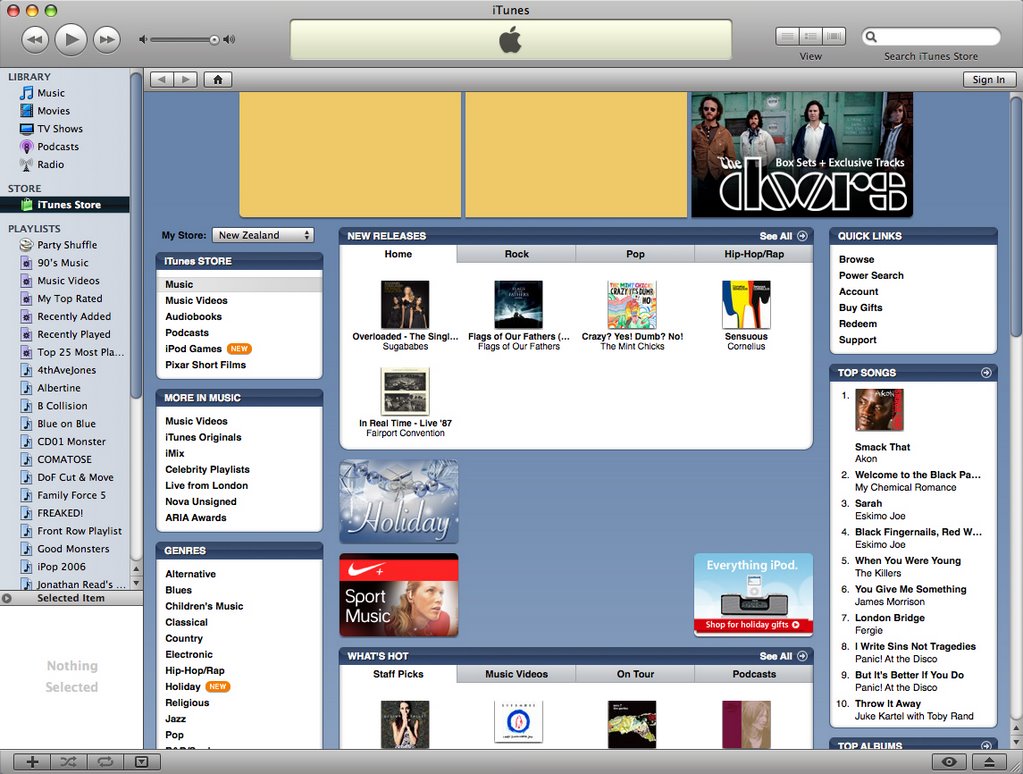 Now Open: The New iTunes Store
Visit New Zealand’s newest entertainment superstore and start building your collection of digital music, music videos, audiobooks, podcasts, and iPod games from the comfort of your computer. Simply launch iTunes 7 on your PC or Mac and click “iTunes Store.” Any time, day or night, you can find and buy what you want in mere seconds. And you can even give gifts with just a few clicks.
So came the news this morning, but alas, the front end does look a little bare, and as per our Aussie cousins, no TV shows or Movie downloads...
Source Dave5 and instructions from polg
Subscribe to:
Posts (Atom)

