


I had to pop into Harvey Noman in Manukau yesterday to look for a modem. I wasn’t really looking forward to going, as I knew they were having a PS3 day, with Mai FM broadcasting live, Spacifix performing and a PS3 give away.
I wasn’t looking forward to the crowds and all the hype and bull.
The first thing I noticed when I arrived was that they had blocked off a premium section of the car park for the Spacifix gig, but there didn’t seem to be too many people around.
On entering Harvey Norman, everything looked normal until I reached the entrance to the electronic section; almost blocking the entrance was a humongous PS3 IDU.
The thing was huge, so big in fact that it reminded me of the old saying about guys who drive big cars….. And it had one kid playing on it.
The modems proved to be overpriced, so I left, had some lunch down by K-Mart and by the time I got back to the car Spacifix were playing to an embarrassingly small crowd, which begs the question:
Have Spacifix had their day, or does Mai FM just not have the listener ship, or does the PS3 just suck big time?
Showing posts with label tech. Show all posts
Showing posts with label tech. Show all posts
Video Games Don't Make You Violent!
According to a new study by a researcher at Texas A&M International University, studies that see a connection between video games and violent behavior usually suffer from shoddy research techniques. Dr. Christopher Ferguson studied the results of a number of recent studies linking violent video games to aggressive behavior with an eye not just to individual results, but also to overall trends in the studies as a whole.
Ferguson found that the connection between violence and gaming had more to do with publication bias than it did with any actual correlation. In other words, journals were more likely to publish studies that supported the hypothesis that playing violent games made a subject more prone to violent behavior. Nothing like scientific stacking the deck, eh? Ferguson sums it up nicely:
Wow, so playing violent video games isn't bad anymore?
SOURCE | Wired
Ferguson found that the connection between violence and gaming had more to do with publication bias than it did with any actual correlation. In other words, journals were more likely to publish studies that supported the hypothesis that playing violent games made a subject more prone to violent behavior. Nothing like scientific stacking the deck, eh? Ferguson sums it up nicely:
Thus it was concluded that there is little evidence from the current body of literature on violent video games that playing violent video games is either causally or correlationally associated with increases in aggressive behavior.
Wow, so playing violent video games isn't bad anymore?
SOURCE | Wired
PS3 Sucks, Again.
Far Cry team leader Cevat Yerli is working on a new game, Crysis, where he says; “Every individual tree in Crysis has more technology applied to it than the whole of Far Cry”
But more importantly, he says of the X-Box 360 and PS3…
"The 360 is a fabulous machine to work on," he says. In particular, "graphics programming is a blast. Microsoft has done a great job with all of their developer-support tools." PlayStation 3 has "tons of power," but "is not as easy to develop for.... Sony's not as good at the developer-support part of things as Microsoft is. I know people in the office (who got) PS3 development kits and (said) they're twice as (expensive), but they're half as capable.
"It's not a bad console; it's certainly far better than everything else except maybe the Xbox 360. In an ideal world PlayStation 3 will be more powerful, but for the vast majority of the cases, you'll be able to effectively exploit more power from the 360."
But more importantly, he says of the X-Box 360 and PS3…
"The 360 is a fabulous machine to work on," he says. In particular, "graphics programming is a blast. Microsoft has done a great job with all of their developer-support tools." PlayStation 3 has "tons of power," but "is not as easy to develop for.... Sony's not as good at the developer-support part of things as Microsoft is. I know people in the office (who got) PS3 development kits and (said) they're twice as (expensive), but they're half as capable.
"It's not a bad console; it's certainly far better than everything else except maybe the Xbox 360. In an ideal world PlayStation 3 will be more powerful, but for the vast majority of the cases, you'll be able to effectively exploit more power from the 360."
Top 5 Worst Things About The iPhone
Just to show that I'm not biased, here's what wired came up with, against the iPhone:
At the risk of sounding churlish—we love the iPhone, we truly do, and will sacrifice our children to get our hands on one—not all is perfect behind the pearly white gates of heaven. Here are the top five worst things about the phone, media player, computer and news frenzy:
1) Cingular. They're North America's largest cellular network, so it makes sense for Apple to deal with them. But it would have been far better if Apple had taken on the carriers' chokehold on handset provisioning wholesale, and simply sold unlocked phones.
2) 8GB Flash drive. For many, it will be more than enough, but the iPhone won't kill the iPod until drive sizes start matching the needs of MP3-era music libraries. My fear is that Apple will stick to its guns and stick with Flash media as it grows to 16GB and beyond, but a second-gen iPhone with magnetic storage is an obvious upgrade path.
3) Built-in battery. Apple's bothersome tradition of non-user-servicable batteries continues. There's no reason to do this, frankly, aside from the kind of implied "we're aesthetic obsessives" claim that Apple still gets away with.
4) No 3G. Fast internet is the horse, 3G is one hind leg.
5) With all those features, a QWERTY keyboard stashed within (somehow) would be the perfect way to turn this little beast into Apple's answer to the UMPC: a cheap, fully-featured computing device in addition to a phone and music player. Even a clamshell...
And I promise, that's all for this week about the iPhone...
At the risk of sounding churlish—we love the iPhone, we truly do, and will sacrifice our children to get our hands on one—not all is perfect behind the pearly white gates of heaven. Here are the top five worst things about the phone, media player, computer and news frenzy:
1) Cingular. They're North America's largest cellular network, so it makes sense for Apple to deal with them. But it would have been far better if Apple had taken on the carriers' chokehold on handset provisioning wholesale, and simply sold unlocked phones.
2) 8GB Flash drive. For many, it will be more than enough, but the iPhone won't kill the iPod until drive sizes start matching the needs of MP3-era music libraries. My fear is that Apple will stick to its guns and stick with Flash media as it grows to 16GB and beyond, but a second-gen iPhone with magnetic storage is an obvious upgrade path.
3) Built-in battery. Apple's bothersome tradition of non-user-servicable batteries continues. There's no reason to do this, frankly, aside from the kind of implied "we're aesthetic obsessives" claim that Apple still gets away with.
4) No 3G. Fast internet is the horse, 3G is one hind leg.
5) With all those features, a QWERTY keyboard stashed within (somehow) would be the perfect way to turn this little beast into Apple's answer to the UMPC: a cheap, fully-featured computing device in addition to a phone and music player. Even a clamshell...
And I promise, that's all for this week about the iPhone...
iPhone Quotes
"Apple Makes My Head iSplode"
“I Feel Like a Caveman For Using Phone Numbers.”
“Who The Hell is Going To Want Anything Else Ever Again?”
"No parent wants to buy their kid a $600 phone, but I think it will make iPods that much cheaper."
"Looking at the specs of this iPhone, it looks like fanart gone wild."
"I don't think anybody is going to be looking at these phones in the same way again"
"It's definitely a compelling product"
"I live in an area that doesn't get Cingular. Everyone can get stuffed."
"So sleek, so clean, so pretty. What is it about Apple products that makes them
look so yummy?"
"Apple have done it again!"
“I Feel Like a Caveman For Using Phone Numbers.”
“Who The Hell is Going To Want Anything Else Ever Again?”
"No parent wants to buy their kid a $600 phone, but I think it will make iPods that much cheaper."
"Looking at the specs of this iPhone, it looks like fanart gone wild."
"I don't think anybody is going to be looking at these phones in the same way again"
"It's definitely a compelling product"
"I live in an area that doesn't get Cingular. Everyone can get stuffed."
"So sleek, so clean, so pretty. What is it about Apple products that makes them
look so yummy?"
"Apple have done it again!"
The iPod is Dead...
 Well, maybe not quite, but with the announcement of the new iPhone, there seems little point in innovating the iPod, besides making the shuffle small enough that it can be worn as an ear-ring.
So once again Apple revolutionises the computer world, and removes the word computer from it's name, essentially saying that they're not just a computer company anymore.
So the iPhone is an iPod looking telecommunications device with a 2 megapixle camera, up to 8GB of RAM, all the features of the latest video iPod, revolutionary web browsing that has a touch sensitive multi format screen.
WOW.
I want one. Trouble is, will it work on the current New Zealand networks?
There's going to be a riot.
 Here's my prediction for Macworld: There's going to be a riot.
Expectations for Steve Jobs' keynote speech Tuesday are so unreasonably high that anything less than an iPod-cum-videophone-miniPC that downloads movies wirelessly from the net and projects them on your living room wall with 7.1 surround sound is going to disappoint.
I've seen it before. I remember one year -- I think it was 2002, when rumors ran rampant that Jobs would unveil a mini-tablet device called the iWalk -- when there was a really strange, ugly mood as he reached the end of his speech and the magical device hadn't been announced.
The crowd looked at each other, saying, "Is that it?" Some people started to advance on the area in front of the stage where Jobs was shaking hands with VIPs and industry execs. I guess most of them wanted to buttonhole Jobs and ask what was going on, but one nut case started shouting and pushing chairs as he moved toward the stage. I remember the startled look on the faces of Jobs' handlers as they ushered the Apple chief backstage and out of the loony's path.
Expectations are higher this year, I think, as Apple moves mainstream and grows. There's more money involved. Still, if Jobs doesn't reveal any miraculous new hardware, you might be able to pick up some plunging Apple stock later in the week.
SOURCE | cult of mac
The Fourth Digital Decade...
 The world of desktop computing is finally going mobile, according to The New York Times John Markoff, and the shift can be seen in the explosive growth of wireless data for cellular carriers.
To handle functions from text and instant messaging to mobile MySpace and ESPN, computer users are increasingly turning to the cellphone.
“We are seeing the emergence of a fourth screen,” said Jerry Panagrossi, vice president for operations at Symbian, a developer of advanced cellphone operating systems, citing a historical progression of “movie, television, computer and now the smart-phone screen.”
The newest screen is evolving to adopt more and more characteristics of a personal computer. And many believe that the next big shift will be the convergence of many forms of communication encompassing voice, e-mail, instant messaging and video telephony.
That shift may well be underscored tomorrow when Steve Jobs, the chief executive of Apple Computer, is expected to unveil an Apple phone representing his company’s new mobile communications strategy — highlighted by a device that may include Jobsian refinements such as a sleek ceramic case and a transparent touch screen.
Hhhmmmm, the iPhone… not something to get me all happy clappy, but no doubt it will be a technological marvel that will have me lusting after it, despite the fact that it won’t be supported in New Zealand for the next four years…
Of course Apple is distinctly late in entering the world of Internet-connected digital hand-helds. Arrayed against it are giants including Nokia, Motorola, Sony Ericsson and Microsoft, in addition to entrenched hand-held companies like Palm and Research in Motion.
Also waiting to enter the fray are powerful Internet companies like Google, who cannot afford to be cut off from users who now rely on them in the desktop computing world.
“Apple is about to touch off a nuclear war,” said Paul Mercer, a software designer and president of Iventor, a designer of software for hand-helds based in Palo Alto, Calif. “The Nokias and the Motorolas will have to respond.”
Oh yeah baby, bring it on. Nuclear war baby…
Read the full article here.
Bill Gates hails 'digital decade'
Microsoft boss Bill Gates has outlined his vision of the connected future, telling experts in Las Vegas: "The digital decade is happening."
Wow, really? The digital decade? So what was the last ten years about?
Bill also told delegates that "connected experiences" were now the most important part of new technologies.
Hhhmmmm, he's sounding more and more like Steve Jobs every day. Only sounding mind you.
Apparently Bill realises that people want to do things with their content across multiple platforms... does that mean that Bill realises that there's more to life than Windows?
Better check, but I think Hell is staring to freeze.
In a speech with few concrete announcements, Mr Gates outlined how his firm's latest operating system Vista would be the tool to connect people.
Ah, so there is only windows, but nothing concrete, yet.
Justin Hutchinson, group product manager, demonstrated a range of new features in Vista, many of which seemed designed to counter arguments from some observers that Apple was the home of creative computing.
Seemed designed to counter arguments.... seemed. So in other words, Apple is still the creative center of the universe. Maybe hell still has some warmth left.
Robbie Bach, president of entertainment devices at Microsoft, revealed that the company had sold more than 10.4m Xbox 360s by the end of 2006.
Ah yes, game consoles, something that Microsoft is good at. If only they focussed totally on gaming and left the computer business to people who know what they're doing...
A range of new PCs from third-party companies using Vista were unveiled at the show, including a white, round media centre PC from Sony designed for watching of movies and music playback in the living room and a touch screen PC from HP.
Ah, a Mac rip off maybe?
Mr Gates also confirmed that next year would see his last keynote speech at CES as he steps down as head of Microsoft.
He said he had offered to come back the following year but that he might "talk more about infectious diseases than software", referring to his philanthropic work.
Whoah, hold up there, maybe there is hope for Microsoft after all, all they have to do is encourage Steve Jobs to sell his soul and go take control of Microsoft.
And yes, I'm an Apple guy, could you tell?
Wow, really? The digital decade? So what was the last ten years about?
Bill also told delegates that "connected experiences" were now the most important part of new technologies.
Hhhmmmm, he's sounding more and more like Steve Jobs every day. Only sounding mind you.
Apparently Bill realises that people want to do things with their content across multiple platforms... does that mean that Bill realises that there's more to life than Windows?
Better check, but I think Hell is staring to freeze.
In a speech with few concrete announcements, Mr Gates outlined how his firm's latest operating system Vista would be the tool to connect people.
Ah, so there is only windows, but nothing concrete, yet.
Justin Hutchinson, group product manager, demonstrated a range of new features in Vista, many of which seemed designed to counter arguments from some observers that Apple was the home of creative computing.
Seemed designed to counter arguments.... seemed. So in other words, Apple is still the creative center of the universe. Maybe hell still has some warmth left.
Robbie Bach, president of entertainment devices at Microsoft, revealed that the company had sold more than 10.4m Xbox 360s by the end of 2006.
Ah yes, game consoles, something that Microsoft is good at. If only they focussed totally on gaming and left the computer business to people who know what they're doing...
A range of new PCs from third-party companies using Vista were unveiled at the show, including a white, round media centre PC from Sony designed for watching of movies and music playback in the living room and a touch screen PC from HP.
Ah, a Mac rip off maybe?
Mr Gates also confirmed that next year would see his last keynote speech at CES as he steps down as head of Microsoft.
He said he had offered to come back the following year but that he might "talk more about infectious diseases than software", referring to his philanthropic work.
Whoah, hold up there, maybe there is hope for Microsoft after all, all they have to do is encourage Steve Jobs to sell his soul and go take control of Microsoft.
And yes, I'm an Apple guy, could you tell?
The (Apple) Year in Review
January
At Macworld, Jobs releases the first Macs with Intel chips: the iMac and 15-inch MacBook Pro (Apple's top-selling machines, not coincidentally). They're six months ahead of schedule. Apple shares soar to a record high.
February
New Mac minis -- but no TV/DVR features as rumor sites had predicted. Jobs is not yet ready to take on the living room.
March
Apple celebrates its 30th birthday -- with a press release. Jobs doesn't like to look back.
April
Hell freezes over: Jobs announces Boot Camp, which allows his new Intel Macs to boot into Windows.
May
The Beatles lose their lawsuit over the Apple name for music sales. Jobs reportedly uses the defeat to negotiate an exclusive deal to sell the Beatles' catalog online.
The 13-inch MacBook is released, completing the laptop line's move to Intel.
Apple and Nike collaborate on the Nike+iPod -- a wireless iPod pedometer and matching sneakers.
June
The stock option scandal grows. A terse statement says an internal probe has uncovered "irregularities," including a grant to Jobs. But Apple says Jobs didn't benefit financially and is working with the SEC. Dozens of other companies are conducting their own backdating investigations.
July
The iPod craze is far from over. Customers snap up 8.1 million iPods in the July quarter, boosting profits by a hefty 50 percent. New Intel Macs sales aren't too shabby, either: 1.3 million Macs are sold, up 12 percent.
August
Jobs gives a weird tag-team keynote at Apple's annual developers conference, prompting speculation about his health following a cancer scare last year. He gives a preview of Leopard, the next major revision of Mac OS X. There are bells and whistles, but the biggest rumored change -- a major UI overhaul to compete with Microsoft's Vista -- is left out.
September
For perhaps the first time ever, Jobs gives a public sneak peek at an unannounced Apple product: the iTV -- a wireless router for beaming video from a computer to a TV. He also unveils iTunes' first feature-length movies. The movie shelf is initially bare, but more are expected next year.
October
The stock options scandal claims a victim. Fred Anderson, Apple's long-time chief financial officer, falls on his sword and resigns from Apple's board. A statement says Jobs knew of irregularities but not their import. It's a strategic mea culpa that's allowed him to skate -- so far.
November
IPhone mania grips the nation. There's nary a week when the iPhone isn't a major story. The speculation is fueled by patent filings and a lot of wishful thinking.
Apple's stock reaches a new high at $93.
December
The iPhone becomes a slam dunk, even if Apple has never officially admitted it's working on it. Wall Street starts issuing iPhone investor advisories.
But as Jobs himself says: "Looking forward, 2007 is likely to be one of the most exciting new product years in Apple's history."
At Macworld, Jobs releases the first Macs with Intel chips: the iMac and 15-inch MacBook Pro (Apple's top-selling machines, not coincidentally). They're six months ahead of schedule. Apple shares soar to a record high.
February
New Mac minis -- but no TV/DVR features as rumor sites had predicted. Jobs is not yet ready to take on the living room.
March
Apple celebrates its 30th birthday -- with a press release. Jobs doesn't like to look back.
April
Hell freezes over: Jobs announces Boot Camp, which allows his new Intel Macs to boot into Windows.
May
The Beatles lose their lawsuit over the Apple name for music sales. Jobs reportedly uses the defeat to negotiate an exclusive deal to sell the Beatles' catalog online.
The 13-inch MacBook is released, completing the laptop line's move to Intel.
Apple and Nike collaborate on the Nike+iPod -- a wireless iPod pedometer and matching sneakers.
June
The stock option scandal grows. A terse statement says an internal probe has uncovered "irregularities," including a grant to Jobs. But Apple says Jobs didn't benefit financially and is working with the SEC. Dozens of other companies are conducting their own backdating investigations.
July
The iPod craze is far from over. Customers snap up 8.1 million iPods in the July quarter, boosting profits by a hefty 50 percent. New Intel Macs sales aren't too shabby, either: 1.3 million Macs are sold, up 12 percent.
August
Jobs gives a weird tag-team keynote at Apple's annual developers conference, prompting speculation about his health following a cancer scare last year. He gives a preview of Leopard, the next major revision of Mac OS X. There are bells and whistles, but the biggest rumored change -- a major UI overhaul to compete with Microsoft's Vista -- is left out.
September
For perhaps the first time ever, Jobs gives a public sneak peek at an unannounced Apple product: the iTV -- a wireless router for beaming video from a computer to a TV. He also unveils iTunes' first feature-length movies. The movie shelf is initially bare, but more are expected next year.
October
The stock options scandal claims a victim. Fred Anderson, Apple's long-time chief financial officer, falls on his sword and resigns from Apple's board. A statement says Jobs knew of irregularities but not their import. It's a strategic mea culpa that's allowed him to skate -- so far.
November
IPhone mania grips the nation. There's nary a week when the iPhone isn't a major story. The speculation is fueled by patent filings and a lot of wishful thinking.
Apple's stock reaches a new high at $93.
December
The iPhone becomes a slam dunk, even if Apple has never officially admitted it's working on it. Wall Street starts issuing iPhone investor advisories.
But as Jobs himself says: "Looking forward, 2007 is likely to be one of the most exciting new product years in Apple's history."
Apple Gives Movies A Face Lift
Deep inside an industrial building in Burbank, California, stands the Great Wall of Macintosh - a humming barrier of 700 Apple Power Mac G5s, all meticulously stacked, one atop the other, in a U shape 8 feet high and 100 feet long. Alongside sits an equally imposing server bay, which stores a staggering 700 terabytes of data. Upstairs in a hypersanitized, temperature-controlled chamber, a technician wearing white silk scrubs hovers over two mammoth, $300,000 digital film scanners.
Wired Test
This monumental collection of gear provides the mathematical brawn behind DTS Digital Images, the world's premier image-processing and -restoration house. This is where Hollywood films come for a face lift - where torn, faded, dirty or otherwise imperfect footage gets surgically enhanced, whether for the archives, a DVD release or a blockbuster opening weekend.
The human brain behind the operation is John Lowry, a bespectacled, auburn-haired man who, at 74, doesn't look a day older than 60. Over the years, Lowry has become known as the film industry's Mr. Fix-It. The movies he has rescued range from the 1933 Boris Karloff vehicle The Ghoul (in which nitrate film base decay had caused excessive flicker and image distortion) to Michael Mann's recent adaptation of Miami Vice (in which a few shots suffered from low light). Even George Lucas sought out Lowry's expertise for the re-release of the Star Wars trilogy ("Lucas hates grain," Lowry says). And MGM hired Lowry to restore all 20 James Bond films for its new set of DVDs.
Many specialists go about restoration manually, cleaning each frame by hand. But as those 700 G5s suggest, Lowry works with computers, faster and more accurately.
"We started out as software developers, but with a very clear direction: to make pictures better," Lowry says as he clicks around the desktop of a Linux machine, picking and choosing from the 50 or so examples stored on his hard drive to show off the technology. "Since each film has its own unique set of problems, it took us about 60 movies to get comfortable."
Today, DTS is a well-oiled machine. As Lowry whirls through a series of before-and-after clips, the differences are obvious. While Sean Connery looks youthfully limber in You Only Live Twice, the 1967 film stock has been ravaged by time, resulting in dirty, jaundiced footage. After a run through Lowry's digital rehab, however, the images are artifact-free: Colors are deeper, detail is better and the images look as fresh as anything shot today.
While Lowry isn't inclined to give up his trade secrets, he admits: "Most of what we do, in the broad sense, is track frame-to-frame differences." Essentially, technicians scan the original film stock onto the server, then proprietary algorithms figure out what shouldn't be onscreen - scratches, discolorations, dirt, mold - and digitally remove it, frame by frame. Think of it as an automatic, high-speed Photoshop retoucher.
But Lowry was doing this long before Photoshop came along. He pioneered image enhancement in the '70s when he processed the Apollo 16 and Apollo 17 moon footage. "Because we'd taken the noise out of the pictures," he says, "the geologists were seeing stuff in the rocks that they'd never seen before."
That sounds like a slightly higher calling than Miami Vice. When asked how he landed here, Lowry's expression turns serious. "I have dyslexia," he says. "I didn't read my first book until I was 30." He pauses, and then smiles. "I'm a picture person."
Source Wired
Wired Test
This monumental collection of gear provides the mathematical brawn behind DTS Digital Images, the world's premier image-processing and -restoration house. This is where Hollywood films come for a face lift - where torn, faded, dirty or otherwise imperfect footage gets surgically enhanced, whether for the archives, a DVD release or a blockbuster opening weekend.
The human brain behind the operation is John Lowry, a bespectacled, auburn-haired man who, at 74, doesn't look a day older than 60. Over the years, Lowry has become known as the film industry's Mr. Fix-It. The movies he has rescued range from the 1933 Boris Karloff vehicle The Ghoul (in which nitrate film base decay had caused excessive flicker and image distortion) to Michael Mann's recent adaptation of Miami Vice (in which a few shots suffered from low light). Even George Lucas sought out Lowry's expertise for the re-release of the Star Wars trilogy ("Lucas hates grain," Lowry says). And MGM hired Lowry to restore all 20 James Bond films for its new set of DVDs.
Many specialists go about restoration manually, cleaning each frame by hand. But as those 700 G5s suggest, Lowry works with computers, faster and more accurately.
"We started out as software developers, but with a very clear direction: to make pictures better," Lowry says as he clicks around the desktop of a Linux machine, picking and choosing from the 50 or so examples stored on his hard drive to show off the technology. "Since each film has its own unique set of problems, it took us about 60 movies to get comfortable."
Today, DTS is a well-oiled machine. As Lowry whirls through a series of before-and-after clips, the differences are obvious. While Sean Connery looks youthfully limber in You Only Live Twice, the 1967 film stock has been ravaged by time, resulting in dirty, jaundiced footage. After a run through Lowry's digital rehab, however, the images are artifact-free: Colors are deeper, detail is better and the images look as fresh as anything shot today.
While Lowry isn't inclined to give up his trade secrets, he admits: "Most of what we do, in the broad sense, is track frame-to-frame differences." Essentially, technicians scan the original film stock onto the server, then proprietary algorithms figure out what shouldn't be onscreen - scratches, discolorations, dirt, mold - and digitally remove it, frame by frame. Think of it as an automatic, high-speed Photoshop retoucher.
But Lowry was doing this long before Photoshop came along. He pioneered image enhancement in the '70s when he processed the Apollo 16 and Apollo 17 moon footage. "Because we'd taken the noise out of the pictures," he says, "the geologists were seeing stuff in the rocks that they'd never seen before."
That sounds like a slightly higher calling than Miami Vice. When asked how he landed here, Lowry's expression turns serious. "I have dyslexia," he says. "I didn't read my first book until I was 30." He pauses, and then smiles. "I'm a picture person."
Source Wired
Live Free or Die Hard
Bruce is back baby, oh yeah. Check out this little teaser for Live Free or Die Hard. I wasn't execting much from this baby, but now I'm kinda excited.
One question I do have though, is why can't there be one central place for movie companies to release their trailers? Apple have a great format and a well set up website, but to see all the latest trailers you have to go all over the place, hoping that the media player will work on you particular computer and browser set up. And if it does work, as it fortunately did with Die Hard, the quality is poor and there are no size options.
One question I do have though, is why can't there be one central place for movie companies to release their trailers? Apple have a great format and a well set up website, but to see all the latest trailers you have to go all over the place, hoping that the media player will work on you particular computer and browser set up. And if it does work, as it fortunately did with Die Hard, the quality is poor and there are no size options.
Yet Another DVD Format Launches
 Just when you were sick of hearing about the high-definition format war and feeling pressured to buy new technology, along comes yet another DVD format to further muddy the waters. Last week Chinese electronics firms unveiled 54 prototype players for a new format called EVD (Enhanced Versatile Disc).
The format boasts more efficient video compression than regular DVDs, better anti-piracy features, and could potentially store HD resolutions. Now, before you get too worked up about the idea, let me just say that this is a format specific to China, and most likely will remain that way.
Apparently licensing fees for the regular DVD format were quite prohibitive to Chinese distributors, so they were seeking their own format to save money. China plans to switch over to the EVD format completely by 2008, and will start exporting the players to other countries early next year, although no U.S. studios have announced plans to support it.
I guess the only effect it may have in North America (and New Zealand) is that it throws a bit of a monkeywrench into the foreign bootleg market. Will I have to buy an EVD player just so I can continue to get $2 DVDs from the Pacific Mall?
Source Film Junk
Apple's Got Game
 Apparently it's all over the internet, again. Sparked by a report by Prudential analyst Jesse Tortora, who offered his opinion that Apple is considering entering the gaming console market. This is not the first time we've seen this particular rumor. Perhaps it keeps coming up because the notion is so very tantalizing. I mean, who wouldn't want to see underdog Apple go up against Microsoft, Sony, and Nintendo with some sort of slick, innovative new game machine?
 Even thought it's nothing but speculation, Tortora makes a solid argument for, pointing out that Xbox and Sony are already encroaching on iTunes' territory as king of digital music and movie downloads. The 360 and PS3 are ready to battle it out with Apple's iPod and upcoming iTV devices, but the games consoles offer more capabilities. By this logic, not entering the console market could actually harm Apple more.
Of course this wouldn't be the first time Apple have looked at Game Consoles...
iTunes NZ Now Open!
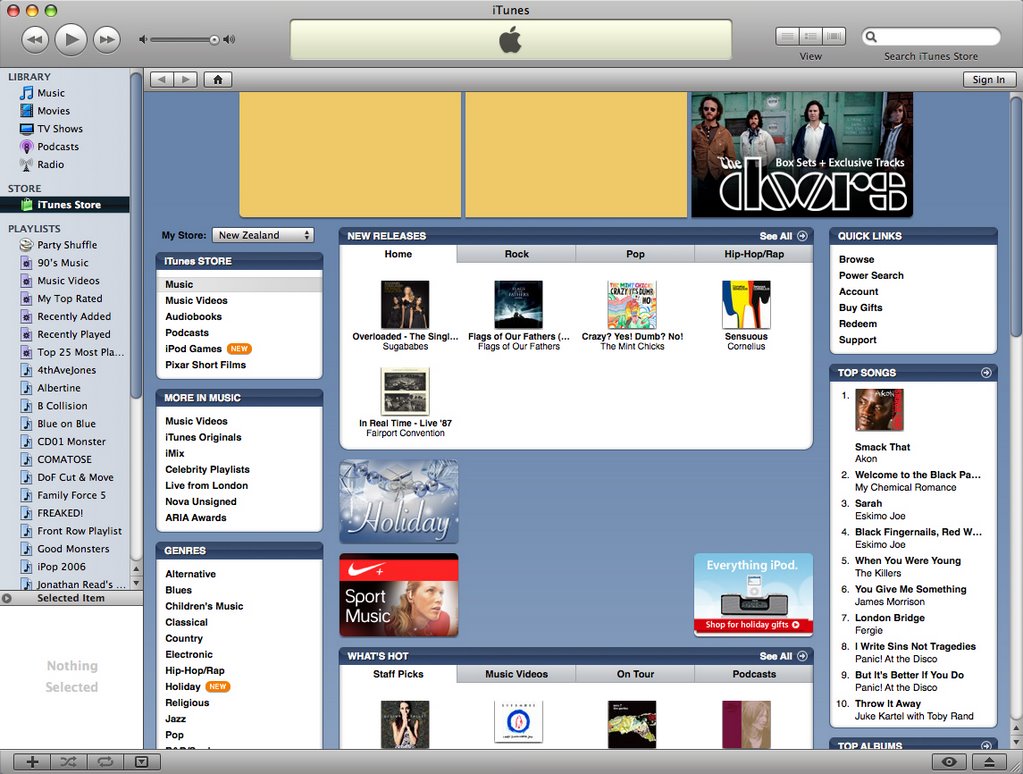 Now Open: The New iTunes Store
Visit New Zealand’s newest entertainment superstore and start building your collection of digital music, music videos, audiobooks, podcasts, and iPod games from the comfort of your computer. Simply launch iTunes 7 on your PC or Mac and click “iTunes Store.” Any time, day or night, you can find and buy what you want in mere seconds. And you can even give gifts with just a few clicks.
So came the news this morning, but alas, the front end does look a little bare, and as per our Aussie cousins, no TV shows or Movie downloads...
Source Dave5 and instructions from polg
Anti PS3 Rants From The Web
Ok, so I’m a 360 boy, but that doesn’t mean I would turn down a free PS3, nor would I buy one just to smash it to pieces in front of long line of Ps3 fan boys, but smashmyps3 does make a funny video…
And to make matters worse for Sony, one of their own PS3 games gets slammed by Wired’s Game Life reviewer:
So PlayStation 3 reviewers got an email this afternoon with helpful tips for Genji, straight from the development team. That's a real interesting coincidence, because I was playing Genji when I got that email and I was coming up with some tips of my own for the development team. Tips like:
• When making a third-person action game, try to develop a camera system that lets the player actually see what's going on around him
• Try to avoid creating puzzles with solutions that involve hitting unseen objects that lie off the boundaries of the screen
• You might want to avoid leaving major bugs in the game that ruin your saved progress and force you to restart the whole thing
So I wasn't too too far into Genji -- I was right at the part where you get the lady warrior Shizuka, about two hours in. And I'd been putting up with unclear mission goals for pretty much the whole time. The game's camera system isn't really good for determining where important, key pieces of scenery are in relation to you. At one point you have to smash a cart so it rolls up to a locked gate, then use it to jump over. But since the camera keeps flipping between two fixed viewpoints, it's tough to tell that the cart would even go up to the gate if you were to push it.
That's minor compared to what happened next. I had to hit two doohickeys that were on top of a roof. But I could only see them in the initial cut scene that set up what I had to do, and even then the camera angle was such that I couldn't see where they were placed in relation to the ground. Checking GameFAQs after getting really frustrated, it turned out that yes, I had to stand underneath the thingamabobs while on the ground, and swing my weapon upwards to hit them.
Not that the game ever told me that I had an upward-facing weapon strike.
Not that there was any way, at all, to see the whatsits, meaning I had to just swing around like an idiot until I randomly hit them.
(Correction: Apparently, what you're supposed to do for this puzzle is get the key, as described below, and use it to enter the building and climb to the roof to hit them. But as I said -- the key was gone!)
But even that wasn't so bad when you compare it to the fact that I didn't know what to do next, and I wasn't finding anything because there was nothing to find. So it was back to GameFAQs' board, but this time there was no solution. Just confirmation that there was supposed to be an item for me to pick up, but due to a glitch in the game it disappears after a certain point. And of course, I'd been diligent and saved my game, meaning I was completely screwed. I'd have to start the game over.
That is, until I realized that -- through sheer coincidence -- I'd copied my old Genji save to a USB thumb drive when testing that feature of PS3. So I loaded it up, worked my way back to where I was, and there was the item I needed. Had I not realized that I had an old save, I wouldn't have bothered. But this is unacceptable, anyway. Simply outrageous that something this obvious would make it through QA.
Ouch.
And this from Geek.com:
Poor Sony. It's bad enough that the PlayStation 3 went through several delays and production shortages to finally see the light of day ... one would think that PS3 launch day would bring a little emotional relief for the electronic entertainment company, right? Not so fast.
Of course everyone knows that the launch of the PS3 was a little chaotic around the U.S. In Boston, however, the mayhem was a little over the top, where 500 hundred customers at Copley Plaza rushed the doors when they were opened at 5 A.M. The resulting riot resulted in damaged property and several injuries from trampling. In the end 12 police squad cars were summoned to control the rampage and many arrests were made.
When the dust settled Boston Mayor Thomas Menino was none too pleased with the carnage, and he directly blames Sony for the problem. In his opinion the riot was caused by Sony keeping the exact number of PS3s at Copley Plaza a secret and not helping to enforce crowd control. So, Mayor Menino has decided to send Sony a bill for the police services needed to bring the PS3-crazy crowd under control.
There are no details of the bill's total or Sony's response to Boston's mayor.
Oh dear.
And then there’s the PS3 720p output issues…
Apparently Sony's kicking off an early Thanksgiving break tomorrow, as they seem to be exhausting themselves today in preparation. After breaking the news that PSP Spots are US bound, floating the PSP 3.0 firmware out, and probably dealing with that massive invoice they just received from Thomas Menino and friends, the company is issuing a quasi-promise that the 1080i / 720p output problems plaguing some distraught PS3 owners will be fixed. Interestingly enough, Sony places a slightly unbelievable amount of blame on "antiquated HDTVs," as if having an HDTV that supports 720p is some sort of hidden requirement to operate a PlayStation 3. While we fully understand that most HDTV sets purchased today will indeed play nice with 720p signals, where's the love for folks who snagged those first generations sets produced by yours truly? According to Sony, a fix is on the way, but it doesn't sound like you'll be getting served with a smile.
And to make matters worse for Sony, one of their own PS3 games gets slammed by Wired’s Game Life reviewer:
So PlayStation 3 reviewers got an email this afternoon with helpful tips for Genji, straight from the development team. That's a real interesting coincidence, because I was playing Genji when I got that email and I was coming up with some tips of my own for the development team. Tips like:
• When making a third-person action game, try to develop a camera system that lets the player actually see what's going on around him
• Try to avoid creating puzzles with solutions that involve hitting unseen objects that lie off the boundaries of the screen
• You might want to avoid leaving major bugs in the game that ruin your saved progress and force you to restart the whole thing
So I wasn't too too far into Genji -- I was right at the part where you get the lady warrior Shizuka, about two hours in. And I'd been putting up with unclear mission goals for pretty much the whole time. The game's camera system isn't really good for determining where important, key pieces of scenery are in relation to you. At one point you have to smash a cart so it rolls up to a locked gate, then use it to jump over. But since the camera keeps flipping between two fixed viewpoints, it's tough to tell that the cart would even go up to the gate if you were to push it.
That's minor compared to what happened next. I had to hit two doohickeys that were on top of a roof. But I could only see them in the initial cut scene that set up what I had to do, and even then the camera angle was such that I couldn't see where they were placed in relation to the ground. Checking GameFAQs after getting really frustrated, it turned out that yes, I had to stand underneath the thingamabobs while on the ground, and swing my weapon upwards to hit them.
Not that the game ever told me that I had an upward-facing weapon strike.
Not that there was any way, at all, to see the whatsits, meaning I had to just swing around like an idiot until I randomly hit them.
(Correction: Apparently, what you're supposed to do for this puzzle is get the key, as described below, and use it to enter the building and climb to the roof to hit them. But as I said -- the key was gone!)
But even that wasn't so bad when you compare it to the fact that I didn't know what to do next, and I wasn't finding anything because there was nothing to find. So it was back to GameFAQs' board, but this time there was no solution. Just confirmation that there was supposed to be an item for me to pick up, but due to a glitch in the game it disappears after a certain point. And of course, I'd been diligent and saved my game, meaning I was completely screwed. I'd have to start the game over.
That is, until I realized that -- through sheer coincidence -- I'd copied my old Genji save to a USB thumb drive when testing that feature of PS3. So I loaded it up, worked my way back to where I was, and there was the item I needed. Had I not realized that I had an old save, I wouldn't have bothered. But this is unacceptable, anyway. Simply outrageous that something this obvious would make it through QA.
Ouch.
And this from Geek.com:
Poor Sony. It's bad enough that the PlayStation 3 went through several delays and production shortages to finally see the light of day ... one would think that PS3 launch day would bring a little emotional relief for the electronic entertainment company, right? Not so fast.
Of course everyone knows that the launch of the PS3 was a little chaotic around the U.S. In Boston, however, the mayhem was a little over the top, where 500 hundred customers at Copley Plaza rushed the doors when they were opened at 5 A.M. The resulting riot resulted in damaged property and several injuries from trampling. In the end 12 police squad cars were summoned to control the rampage and many arrests were made.
When the dust settled Boston Mayor Thomas Menino was none too pleased with the carnage, and he directly blames Sony for the problem. In his opinion the riot was caused by Sony keeping the exact number of PS3s at Copley Plaza a secret and not helping to enforce crowd control. So, Mayor Menino has decided to send Sony a bill for the police services needed to bring the PS3-crazy crowd under control.
There are no details of the bill's total or Sony's response to Boston's mayor.
Oh dear.
And then there’s the PS3 720p output issues…
Apparently Sony's kicking off an early Thanksgiving break tomorrow, as they seem to be exhausting themselves today in preparation. After breaking the news that PSP Spots are US bound, floating the PSP 3.0 firmware out, and probably dealing with that massive invoice they just received from Thomas Menino and friends, the company is issuing a quasi-promise that the 1080i / 720p output problems plaguing some distraught PS3 owners will be fixed. Interestingly enough, Sony places a slightly unbelievable amount of blame on "antiquated HDTVs," as if having an HDTV that supports 720p is some sort of hidden requirement to operate a PlayStation 3. While we fully understand that most HDTV sets purchased today will indeed play nice with 720p signals, where's the love for folks who snagged those first generations sets produced by yours truly? According to Sony, a fix is on the way, but it doesn't sound like you'll be getting served with a smile.
Testing PS3 "Remote Play" on PSP
 It seems that Sony has failed to deliver yet again on the benefits of it's much touted PS3, this just in from Wired's Game Life:
Let me explain what you're seeing: that's the PSP, wirelessly connected to the PS3, displaying the PS3's Web browser, which is being controlled with the PSP's buttons. (You're also seeing lots of dust. Man, the PS3's just a goddamn magnet for the stuff.)
This is the much-touted Remote Play capability of PS3 in action, the convergence of Sony's two machines. They've talked this up quite a bit, but they haven't made it clear what, exactly, you can do. There are a lot of misconceptions -- some of which, a few hours ago, were held by me. So here's what you can and can't do with Remote Play.
You CAN:
...view your PS3's Cross Media Bar menu on your PSP. It looks exactly as it does on your TV, just scrunched down smaller -- small enough that you can barely read the text. Anything you do here is actually taking place on the PS3. You're just using your PSP as the controller, and the PSP's screen as the display.
...use movies, pictures, and music that you have stored on your PS3 hard drive or on any external device connected to PS3. So you can be watching a movie file on your PS3, then if your mom tells you to turn off the TV and go to bed, you can turn it off but keep watching on your PSP, under the covers with headphones.
I hope you kids get a lot of use out of that little tip because that's just about the only possible usage I can think of for Remote Play at this point. Because...
You CAN'T:
...use this over the internet. You're not logging into your PS3 remotely, it's all local connecting directly between your PS3. That means that you have to have the 60GB PS3 model -- the one with built-in wireless -- or an external wireless adapter for PS3 to make this happen.
...display PS3 games on PSP. So no playing Gundam on the small screen. Similarly, no watching DVDs or Blu-Ray.
...use the PS3 as a wireless access point for PSP. Which is kind of ridiculous, as this would be an actually useful application. I don't have a wireless router and Sony hasn't released any solution like Nintendo's USB Wi-Fi dongle. PS3 would be an excellent way for me to play online PSP games... but isn't.
...do this without upgrading your PSP system software to 3.00. Right now you can get it through the Network Update function, but it's not on Sony's official site for download yet. (It is, however, on hacker site PSP Updates.)
I think you also need 3.00 to download PS1 games through the PlayStation Store and run them on your PSP. But insofar as there are no games available on the Store yet, I can't exactly test this function. Sony's just trying to keep us all in suspense.
Xbox Steps Up
Taking another step further in making the XBox an entertainment-based console rather than just a video game machine, Microsoft has announced a plan to make movies and TV shows available for download through the XBox and XBox Live. Microsoft has partnered with Warner Bros. Home Entertainment, Paramount Pictures, CBS, MTV Networks, Turner Broadcasting System Inc. and Ultimate Fighting Championship to deliver a variety of programming to users.
Beginning on November 22nd (the first anniversary of XBox 360), XBox Live will feature rental HD copies of movies like Nacho Libre, Superman Returns, Mission:Impossible 3 and Batman Begins as well as download-to-own TV shows like "CSI," "South Park" and "Star Trek." Microsoft also hopes to have over 1,000 hours of downloadable content available by the end of the year. Oddly, none of the programming will be transferable to Microsoft's new Zune player, which they hope will compete with iPod. So far a pricing structure and file sizes have not been announced.
The question of course is; will there be enough room for iTunes, Google, Xbox and (eventually) Sony having their own download services? Who will win? Who will fail?
But more importantly for Kiwi XBox gamers, will this service be available in New Zealand? I’m awaiting news from XBox New Zealand, but I’m not hopeful. When Apple announced it was in the movie downloading business, there were severe regional restrictions outside of the US, and with New Zealand having no iTunes store, there was nothing for Kiwis. Similar can be expected with the XBox, as regional TV and Film distribution is owned by different companies, where as the XBox model would see all the revenues going back to the States, by passing the licensing deals struck with companies in New Zealand.
However, if Microsoft have thought this through and dealt with these issues, then the only thing left would be delayed releasing for different regions. Then the only issue is, would anyone in New Zealand be bothered downloading a movie with New Zealand’s archaic broadband speeds?
Beginning on November 22nd (the first anniversary of XBox 360), XBox Live will feature rental HD copies of movies like Nacho Libre, Superman Returns, Mission:Impossible 3 and Batman Begins as well as download-to-own TV shows like "CSI," "South Park" and "Star Trek." Microsoft also hopes to have over 1,000 hours of downloadable content available by the end of the year. Oddly, none of the programming will be transferable to Microsoft's new Zune player, which they hope will compete with iPod. So far a pricing structure and file sizes have not been announced.
The question of course is; will there be enough room for iTunes, Google, Xbox and (eventually) Sony having their own download services? Who will win? Who will fail?
But more importantly for Kiwi XBox gamers, will this service be available in New Zealand? I’m awaiting news from XBox New Zealand, but I’m not hopeful. When Apple announced it was in the movie downloading business, there were severe regional restrictions outside of the US, and with New Zealand having no iTunes store, there was nothing for Kiwis. Similar can be expected with the XBox, as regional TV and Film distribution is owned by different companies, where as the XBox model would see all the revenues going back to the States, by passing the licensing deals struck with companies in New Zealand.
However, if Microsoft have thought this through and dealt with these issues, then the only thing left would be delayed releasing for different regions. Then the only issue is, would anyone in New Zealand be bothered downloading a movie with New Zealand’s archaic broadband speeds?
Subscribe to:
Posts (Atom)

